Illustration of a person building software from their sofa with floating app interfaces and dashboard elements
TL;DR
- Vibe coding has made building software almost free. That's the easy part. The hard part - the part that actually determines whether you make money - is building something someone will pay for and figuring out how to reach them.
- Five models are working right now: micro-SaaS, prototyping sprints, AI agents, freelance builds, and building in public. Real numbers and sources below.
- The pattern across all of them: the people making money found the problem before they opened Cursor. They sold before they built. And they had an unfair advantage - usually their professional background - that told them exactly which problem was worth solving.
Ten grand. That's what my first app made when I was 15. I had no real idea what i was doing but the fact that i could make something, put it in front of people, and they'd actually pay for it, that stuck with me. Then I went and did the sensible thing, got my accounting degree, did a stint at Goldman Sachs, became an ACA chartered accountant, worked in finance at a couple of startups (Prolific, then Togather). The whole time though, i had stuff going on the side. I ran a portrait photography business called The Portrait Code for years while working full time. So I've always been the person with the day job and the side thing.
That's why i built sidething. Because i knew what it felt like to be building something at 10pm after a full day of finance work and having nobody around who got it.
I bring this up because when i talk about how to monetize vibe coding, i'm not theorising. I've been the person with the side project, the day job, and the question of "how do i actually get someone to pay for this." And now through sidething i've spoken to about 50 people trying to do the same thing this year. Some are making real money. Most aren't. And the gap between them has almost nothing to do with how good they are at building.
The tools have gotten ridiculous. Cursor just crossed $2B in annualised revenue, doubling in three months. Lovable hit $100M ARR in eight months. Replit's at $253M ARR growing 2,352% year-over-year. Building software without traditional coding skills is properly real now. You describe what you want, the AI writes most of it, you tweak and ship.
But that's the bit everyone's already figured out. The bit almost nobody talks about is what happens after you ship. How do you get your first five paying customers? How do you know if the thing you're building is something anyone actually wants? How do you price it? Where do you even find the people who need it?
That's what this post is actually about.
The five models that are working right now
Before i get into the hard stuff, let me lay out the landscape. These are the five ways i'm seeing people actually monetize vibe coding in 2026. Not theoretical, not "you could try this" - people are doing these and making real money.
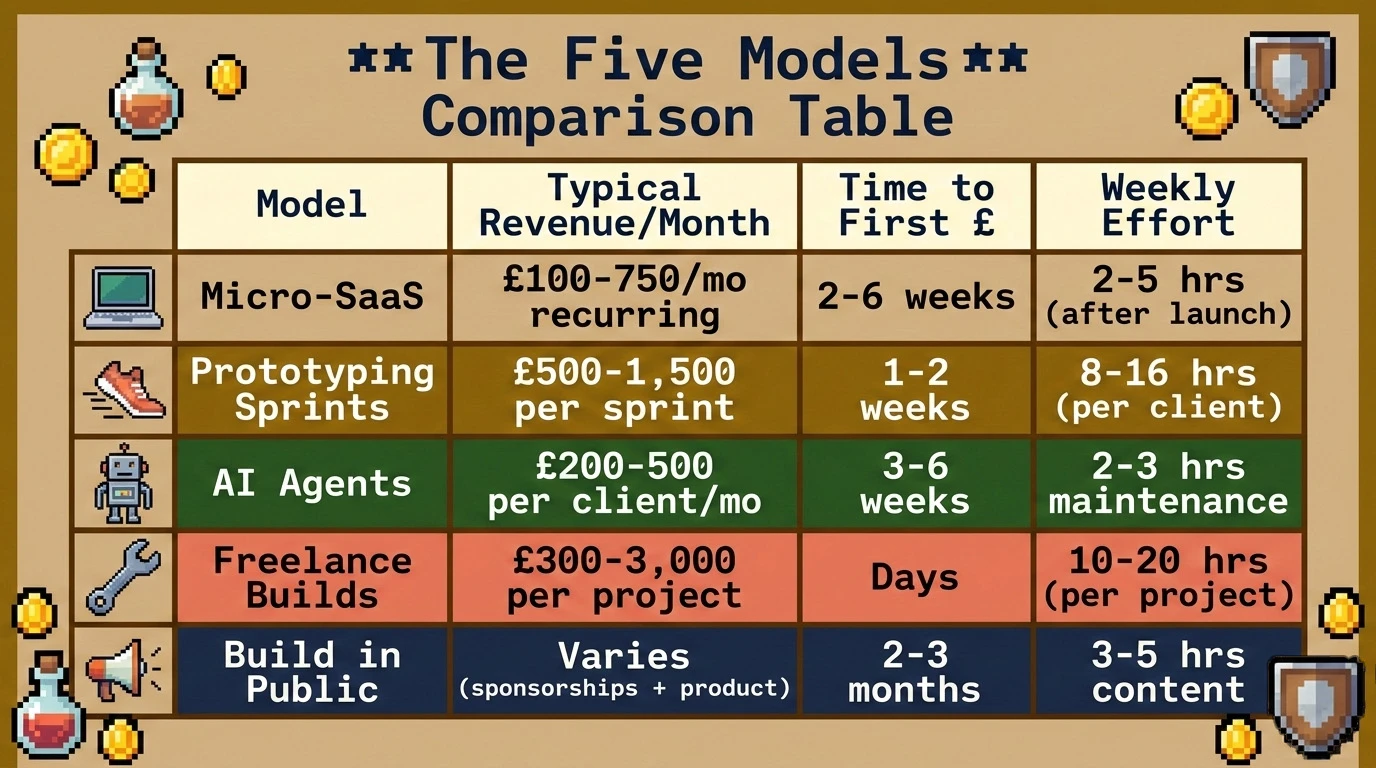
Micro-SaaS - find a tiny, specific problem. Build a tiny, specific tool. Charge £5-15/month. One non-developer built a property description tool to $3,200/month without writing a single line of code. AirTrackBot is doing $7k/month, StageTimer.io is at $8.3k/month. According to Freemius's 2025 State of Micro-SaaS report, the median profitable micro-SaaS makes about $4.2k MRR and 68% of successful solo founders used AI primarily for development speed.
Prototyping sprints - a founder has an idea, you build them a working clickable prototype in 48 hours using Cursor or Bolt. People charge £500-1,500 per sprint. The actual building takes maybe 4-8 hours, so the effective hourly rate is absurd. About half the time the client comes back wanting you to build the full thing.
AI agents - build a bot that does one specific job. A support agent for Shopify stores. A lead qualifier for a real estate website. A scheduling assistant for a dental practice. You're selling the labour it replaces. A business paying someone £12/hour for repetitive emails will happily give you £200/month for a bot that does it 24/7. The vibe-coding startup Anything hit $2M ARR in its first two weeks building exactly these kinds of workflows.
Freelance builds - small businesses need websites, landing pages, booking systems, internal tools. One freelancer documented making $612 in a single month building simple web apps for local businesses. There's already a whole category on Upwork for vibe coding freelancers.
Building in public - document your process, share your numbers, build an audience. Sebastian Volkis built TrendFeed in four days and hit $12k in revenue within four weeks. He's now reportedly clearing around $25k/month from AI-built apps.
You'll also see people talk about the viral consumer app model - someone vibe codes a game or a novelty app, it goes viral, and they make a fortune from ads. It happens. But it's lottery-ticket thinking, not a repeatable playbook, so i've left it off this list.
Those numbers are real. But they're the highlight reel. For every person making $3,200/month from a micro-SaaS, there are probably twenty who built something, put it on Product Hunt, got twelve upvotes, and quietly moved on. The difference between them isn't building skill. It's everything else.
What actually separates the people making money
I've been watching this pattern long enough now to see what the people who make money have in common. It's not what most "how to monetize vibe coding" posts will tell you.
They found the problem before they opened Cursor
The property description tool guy didn't wake up one morning and think "i should build a SaaS." He'd spent years as an estate agent, writing property descriptions by hand, knowing exactly how painful it was and exactly who else had the same problem. The tool was the last step, not the first.
This is what people mean by founder-market fit, and it matters more than anything else. The best vibe-coded products i've seen come from people who have deep, boring, specific knowledge about one industry. They know the annoying manual task. They know who does it. They know what those people would pay to make it go away. They know where those people hang out online.
If you don't have that - if you're just browsing Reddit for "SaaS ideas" - you're starting from the wrong place. Start from a problem you've personally experienced or one you can see first-hand through your job, your network, or your own life.
When i was doing month-end close at Prolific, i could've listed twenty tasks that were crying out to be automated. When i was running The Portrait Code, i knew exactly what tools photographers were overpaying for. That kind of insider knowledge is the actual moat. Not the code.
They sold the ugliest possible version first
This one goes against every instinct. You want to make it good before you show anyone. You want to add that one more feature. You want the landing page to look professional.
Don't. The people making money charged for the worst possible version they could get away with. One feature. Barely works. Looks terrible. But it solves the specific problem for the specific person, and they're willing to pay for it anyway. That's your signal.
I've seen people spend three months polishing an app that nobody wanted. I've also seen people charge £10/month for a Google Sheet with a macro that saves someone two hours a week. The second one is a business. The first one is a hobby.
If five people won't pay for the ugly version, fifty people won't pay for the pretty one. Test the willingness to pay before you test anything else.
They knew how to reach their people
"Post it wherever your niche hangs out online" is advice that sounds helpful but actually isn't. Most people have no idea where mobile hairdressers hang out online. Or independent physiotherapists. Or dog walkers.
The people making money did the unglamorous work of figuring this out. They joined Facebook groups for their niche. They found the subreddits. They went to industry meetups (yes, in person). They DM'd people on LinkedIn. They commented on posts. They built relationships before they had anything to sell.
Sebastian Volkis didn't go viral by accident. He'd been building in public for months before TrendFeed took off. The $12k in four weeks came off the back of an audience he'd been nurturing. The four-day build was the spark. The kindling was already there.
For prototyping sprints and freelance builds, your first few gigs will come from people who already know and trust you. If you don't have that network yet, this model takes longer to get off the ground. That's not a reason not to do it - it's a reason to start building relationships now, before you need them.
With AI agents, the sell is even harder. You're asking a business owner to trust a bot with their customer interactions. That takes credibility. It takes a demo that works flawlessly on their data, not a generic pitch. Domain knowledge is your way in - you can speak their language because you've lived their workflow.
They priced on outcomes, not effort
My finance brain keeps coming back to this. Having spent years building financial models at Prolific around unit economics, i see the same principle everywhere: charge for what the output is worth to the customer, not what the input cost you.
"I'll build your website" is worth £500. "I'll build you a system that books 10 more clients per month" is worth £2,000. Same amount of work. Completely different framing.
If a bot saves a dental practice 15 hours of admin a week, that's worth maybe £800/month to them. Charging £200/month is an easy yes. The fact that it took you a weekend to build is irrelevant to the customer, and it should be irrelevant to your pricing.
This is how the same work earns wildly different amounts across the five models. The freelancer charging per project caps out. The one charging per outcome scales.
The stuff nobody talks about
Here's the honest bit. Every success story has a chapter in the middle that doesn't make for a good tweet.
Getting your first five paying customers is the whole game
Not your first fifty. Your first five. Five people who give you actual money, not "yeah I'd definitely use that" over coffee. The gap between interest and payment is enormous. People will tell you your idea is great because they want to be supportive. They will not tell you they'd never actually pay for it.
The way to close this gap is to ask for money early. Before you've built anything meaningful. "I'm building a tool that does X for people like you. I'll charge £10/month. Can i build it for you and you'll be my first customer?" Most people will say no. That's fine. You're looking for the ones who say yes with their wallet, not their words.
The boring middle is where most people quit
You've built the thing. You've got two, maybe three paying customers. Revenue is £30/month. Your friends think you're doing well because you posted about it on LinkedIn. But £30/month is not a business, and the next bit - grinding from £30 to £300 to £3,000 - is repetitive, unsexy, and takes months.
Every person i've spoken to who's making real money went through this phase. The temptation to scrap it and start something shinier is constant. The ones who made it through kept talking to their customers, kept iterating on the one thing that mattered, and kept showing up. That's it. No secret.
Your professional background is the biggest advantage nobody's using
Everyone talks about the tools. Cursor this, Lovable that. But the actual unfair advantage is sitting in your CV.
Finance people know which manual processes cost businesses thousands of hours. Lawyers know which compliance tasks are repetitive and error-prone. Healthcare administrators know which booking systems are garbage. Recruiters know which parts of hiring are tediously manual. Consultants have seen the same inefficiency across dozens of companies.
That knowledge - the kind you accumulate by doing a boring job for three years - is worth more than any prompt engineering course. It tells you what to build, who to sell it to, and how much to charge. The tools just let you build it without needing to hire a developer.
This is what i think about a lot with sidething. The community isn't full of developers learning to code. It's full of professionals with domain expertise and a side project they want to make real. The vibe coding tools have unlocked them. The question is whether they'll lean into their unfair advantage or try to compete in spaces they don't know.
What I'd do if I were starting this weekend
Not "build something." That's too vague and it's what everyone says. Here's the actual playbook:
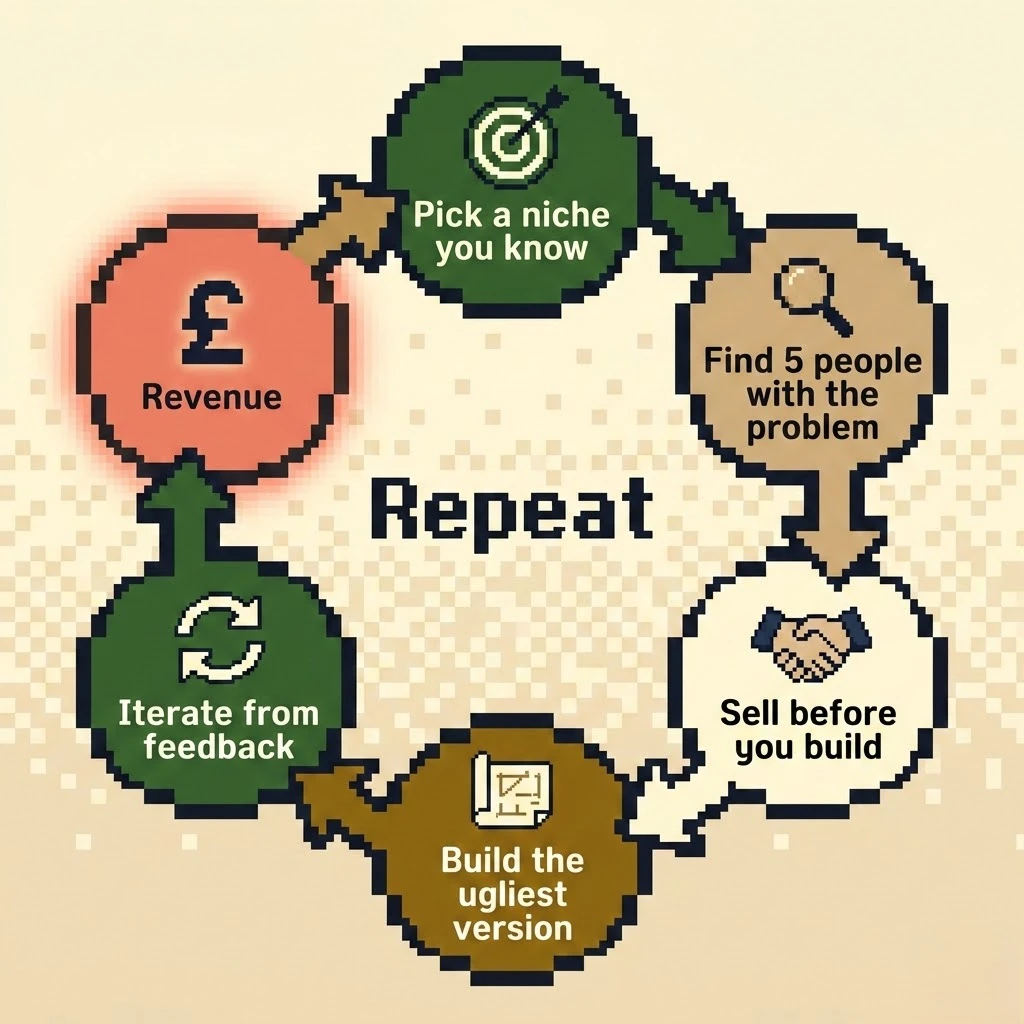
Friday evening: Write down three problems you personally deal with at work or in your life that are annoying and repetitive. Pick the one where you also know other people who have the same problem.
Saturday morning: Message five of those people. Not a sales pitch. Just: "I'm thinking about building a tool that does X. Would that save you time? What would you pay for it?" Listen to what they say. If three or more say they'd pay, you've got something.
Saturday afternoon: Open Cursor or Lovable and build the single ugliest feature that solves the core problem. One feature. No login page. No settings. No "nice to have." The thing that makes the pain go away.
Sunday: Put it in front of those five people. Ask for £5-15/month. If even two say yes, you have a business. If nobody pays, you've saved yourself months of building the wrong thing.
Total cost: Cursor is $20/month. Lovable's $29/month. Less than a gym membership. When i started The Portrait Code alongside my finance career, i spent £2,000 on camera gear before i made a single pound back. The economics of testing an idea in 2026 are insanely different.
The low cost means you can afford to be wrong. Do this three or four times and you'll find the one that sticks. The people making real money from vibe coding didn't get lucky on their first try. They got disciplined about killing ideas that weren't working and doubling down on the ones that were.
If you want to be around other people figuring this out, sidething might be your thing. I built it because i wanted the community that didn't exist when i was getting started - the place for people with day jobs and side projects who want to actually build something real. We're still early but thats kind of the exciting part. Check out what we're about at sidething.com/use-cases.
FAQ
What is vibe coding?
Vibe coding is building software by describing what you want in plain English and letting AI tools like Cursor, Replit, or Bolt write the code. You're the product owner and editor, not the programmer. The term was coined by Andrej Karpathy in early 2025 and its gone mainstream since. sidething is a community for people who want to turn these skills into actual income.
How do you actually monetize vibe coding?
Five models are working in 2026: micro-SaaS products (£5-15/month for niche tools), prototyping sprints for founders (£500-1,500 per sprint), AI agents that replace manual work, freelance builds (£300-3,000 per project), and content about your building process. But the model matters less than the problem you're solving. Pick a narrow audience, validate that they'll pay, and build the simplest thing that solves their problem. None of these are instant - expect weeks to months before consistent income.
What tools do you need for vibe coding?
The core stack most people start with: Cursor ($20/month) for AI-assisted coding, Replit (free tier available) for browser-based building, Lovable ($29/month) or Bolt for rapid prototyping. For AI agents, you'll want n8n or Make for workflow automation, plus Claude or GPT-4 APIs. Total cost to get started is under £50/month. You don't need all of them - most people pick one and go.
Can you make money from vibe coding without being a developer?
Yeah. One non-developer built a $3,200/month micro-SaaS without writing a single line of code. Sebastian Volkis, who built a $12k product in four days, isn't a developer either. The edge comes from knowing a specific industry, not from programming ability. But "not a developer" doesn't mean "no effort" - you still need to understand your users and do the unglamorous work of selling.
Is vibe coding replacing developers?
No. The boring scaffolding work (CRUD apps, landing pages, simple automations) is getting automated. But complex architecture, security, and systems that scale to millions of users still need proper engineering. What's happening is the floor has been raised - people who couldn't build anything before can now build simple, useful software. That opens up a massive new category of builder who sits between "non-technical" and "developer." Thats where the vibe coding money opportunity lives.
Is vibe coding a real business or just hype?
The tools are real and accelerating. Lovable hit $100M ARR in eight months. Cursor crossed $2B in annualised revenue. Replit's at $253M ARR growing 2,352% year-over-year. Individual builders are making $500-5,000/month from stuff they vibe coded. But building something isn't the same as building a business. The tools solve the first problem. Finding customers, pricing right, and sticking with it through the boring middle - that's still on you
keep reading



ship your side project.
we turn your scattered to-do list into a roadmap, with the accountability to actually do it.

 sidekick online