in this post
sidething was already good at its job. Your sidekick built your roadmap, broke it into bite-sized tasks, and kept you moving. But it was working from a single source: you.
What you typed in onboarding. What you said at check-in. What you marked done. That was the whole picture.
It did a lot with a little. But it was hungry. Go quiet for a week and it went quiet too. Tell it you'd landed a few users and it had no way to check whether that turned into revenue. It took you at your word, because your word was all it had.
So we gave it eyes.
What "plugged into your stack" means
sidething intelligence connects to the tools your business already runs on. Not a random grab-bag of integrations. The six things that, together, are your stack:
- Your payments. Revenue, MRR, churn, and the customers who just showed up.
- Your product data. Signups, growth, and what's moving in your database.
- Your email. The threads going unanswered and the follow-ups slipping.
- Your calendar. Your meeting load and who's coming up next.
- Your call transcripts. The objections, the asks, and what you promised on a call.
- Your code. Shipping velocity, open PRs, and the work going stale.
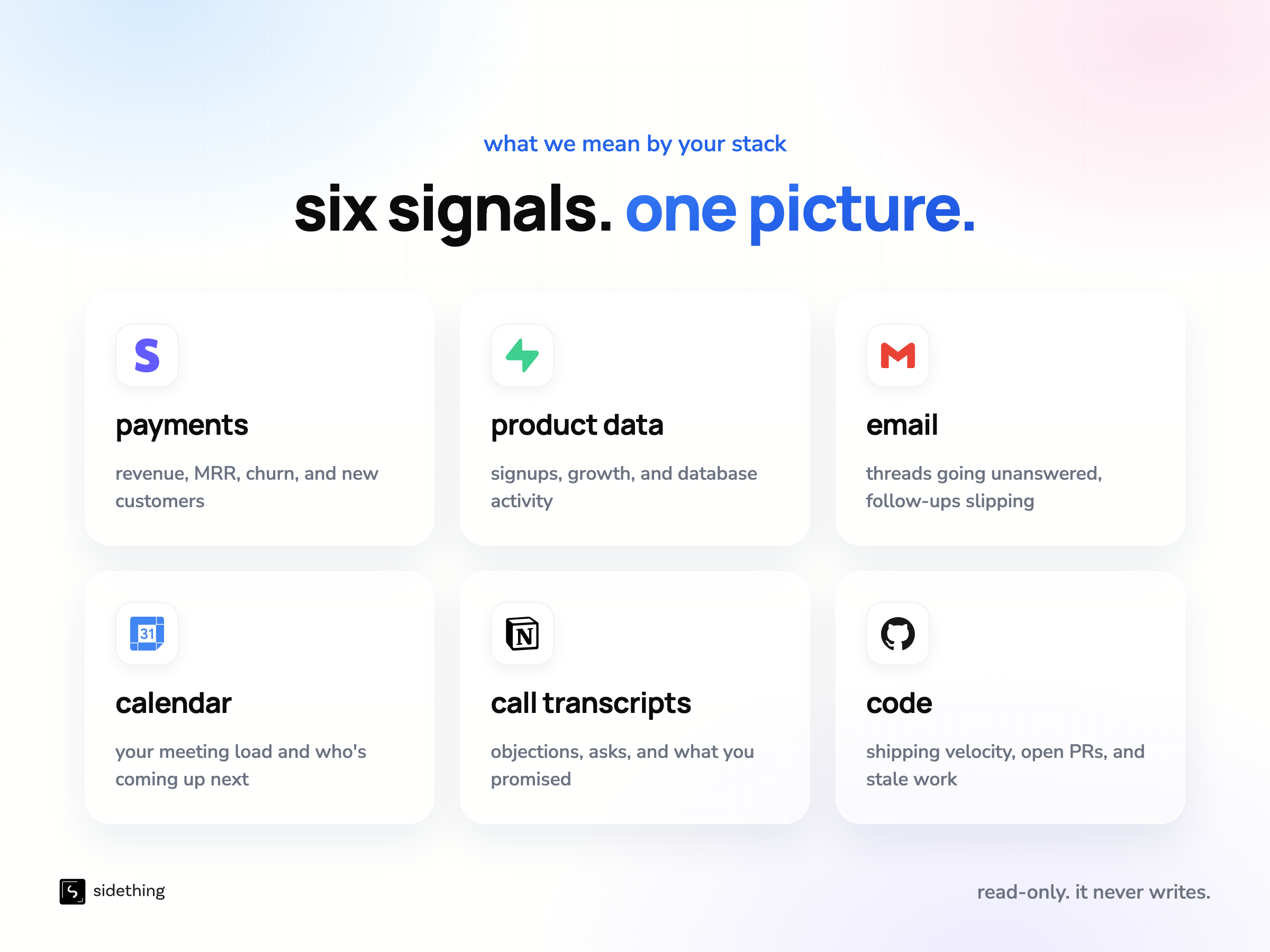
Connect what you use, skip what you don't. sidething reads across all of it and builds one picture of your business.
Why this changes everything
Three things happen the moment sidething can see for itself.
It can verify. You don't have to tell it your revenue. It knows. When what you say and what's true start to drift apart, that gap becomes a signal instead of a blind spot.
It gets proactive. It stops waiting for you to check in. It reads your stack on its own, finds what matters this week, and brings it to you. "Your trial-to-paid dropped to 8%. You've got 23 active trials. Here's the playbook."
Your roadmap gets smarter. A plan built on what's happening in your business beats a plan built on a form you filled in three weeks ago. Every cycle, it knows more.
And it opens a door we're only starting to walk through: agents built for your business specifically. Not a generic assistant that could belong to anyone. One that knows your numbers, your customers, and your code.
The part nobody else does
Plenty of tools connect to Stripe. Some read your email. Almost nobody connects to your database, and the ones that do don't know what to do with it.
We do. When you connect a source, sidething runs a discovery pass and builds custom skills for that connector. It learns your users table, your revenue object, the core thing your product is about. So it isn't pulling rows. It's reading your business the way a co-founder who'd been there for months would.
That's the part that's hard to copy. It's also the part that makes the difference.
What it will never do
This matters as much as the rest.
Every connection is read-only. sidething reads your Stripe data, it never creates a charge. It reads your Gmail, it never sends an email. It reads your calendar, it never books anything.
It suggests, you decide. Nothing lands on your roadmap unless you put it there. And every insight tells you where it came from: "From your Stripe data." "From a call transcript on Tuesday." You're always in control, and you can always see the receipts.
Who it's for
If you've shipped something and you're trying to turn it into real revenue, this is for you. The founder juggling a job, a build, and a dozen browser tabs, who doesn't have time to be their own analyst every week. sidething already worked out what to do next. Now it can see whether it's working.
Connect your first source in settings, and sidething starts learning immediately. Everything you already have keeps working the way it did. This is additive.
Your stack has been trying to tell you something. Now sidething is listening.
ship your side project.
we turn your scattered to-do list into a roadmap, with the accountability to actually do it.

 sidekick online